CORRUGATED PACKAGING & PROCUREMENT
Why Corrugated Box Dimensions Matter More Than the Price Per Box
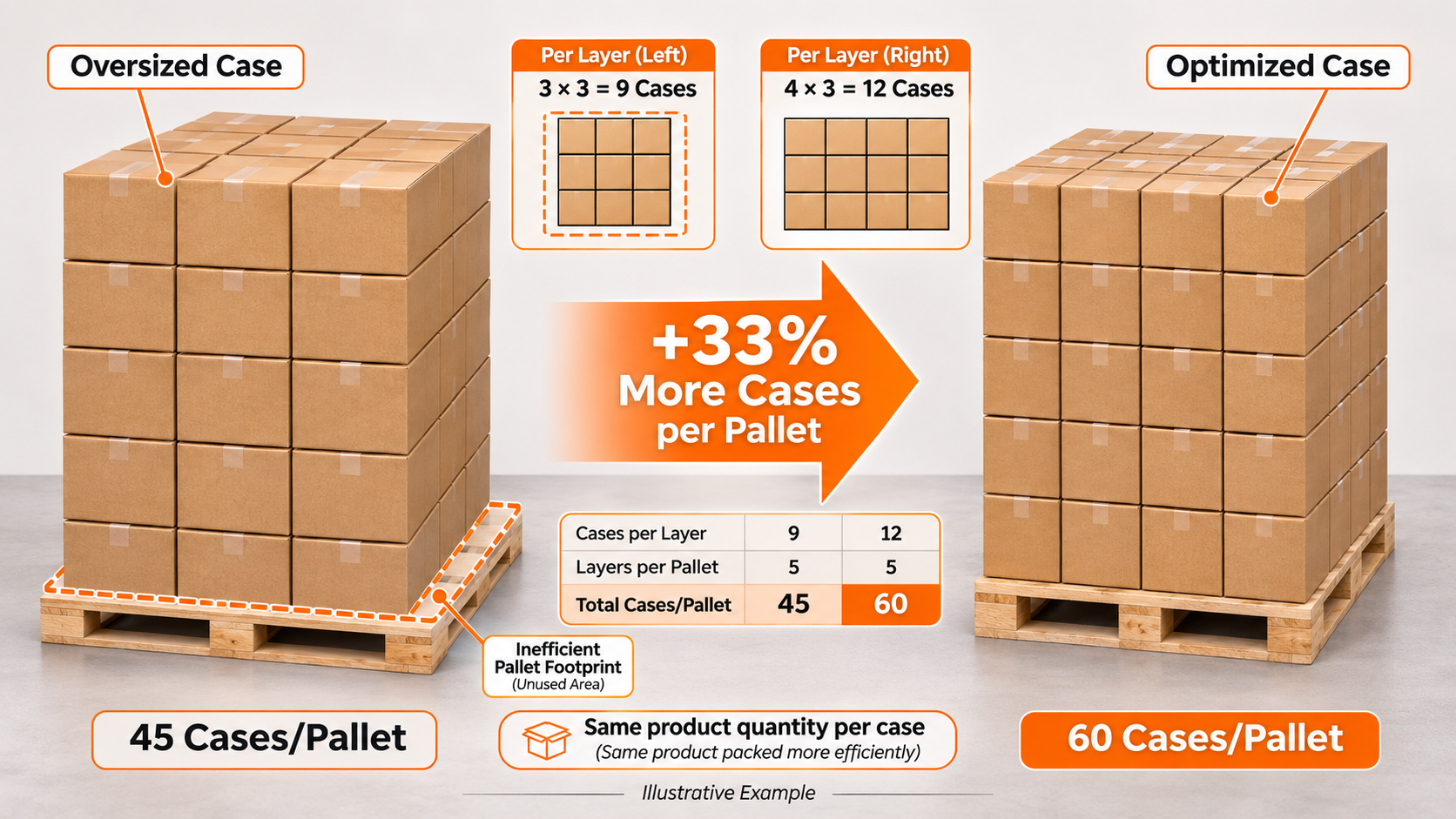
A cheaper box doesn’t always mean cheaper packaging. Sometimes a small change in dimensions can create savings that a lower unit price never will.
When purchasing managers compare corrugated packaging quotes, the first number they usually examine is the price per box.
And understandably so.
When a manufacturer purchases hundreds of thousands of shipping cases annually, a few cents per box can add up quickly.
But there’s another number that deserves just as much attention.
How many finished cases fit on a pallet?
Because the box that costs less to purchase isn’t necessarily the box that costs less to ship.
The Hidden Cost of Corrugated Box Dimensions
Imagine a manufacturer purchasing 500,000 corrugated shipping cases annually.
One supplier quotes $0.82 per box.
Another quotes $0.86.
That’s a $20,000 annual difference in packaging purchases.
The cheaper option looks like the obvious winner.
But what if the more expensive box has dimensions that allow more finished cases to fit on each pallet?
That change could reduce the number of pallet loads moving through the distribution network, along with certain handling, storage, and transportation expenses.
Suddenly, four cents per box isn’t the only number that matters.
The real question becomes: What does each finished case cost after it moves through distribution?
What Happens When 45 Cases Become 60?
Consider two hypothetical corrugated case designs on a standard 48-by-40-inch pallet.
Both hold the intended product, meet the necessary protection requirements, and support five layers of stacking.
The difference is their external dimensions.
| Current Case | Optimized Case | |
|---|---|---|
| Outside dimensions | 16” × 12” | 15” × 10” |
| Cases per layer | 9 | 12 |
| Layers per pallet | 5 | 5 |
| Cases per pallet | 45 | 60 |
The revised footprint accommodates 15 additional cases per pallet.
That’s 33.3% more cases per pallet.
Now consider the effect across 500,000 finished cases annually.
The original configuration requires approximately 11,112 pallet loads.
The optimized configuration requires approximately 8,334.
That’s approximately 2,778 fewer pallet loads annually.
These figures are illustrative, not a documented customer result. They assume the same product quantity and protection fit both case designs, five stable layers are achievable, and no other operating restrictions prevent the change.
The key point is that packaging dimensions can change the economics of an entire distribution program.
More cases per pallet doesn’t automatically mean lower freight charges, particularly when shipments are limited by weight, delivery requirements, or trailer loading constraints. But the potential is significant enough to evaluate.
Why Do Manufacturers Keep Using Inefficient Boxes?
In many facilities, corrugated specifications have been in place for years.
A shipping case gets approved, production begins, and purchasing continues ordering the same part number.
As long as the box arrives on time, runs through the equipment, and protects the product, there may be little reason to question it.
Meanwhile, other things change.
Products are redesigned. Pack counts change. Distribution networks expand. Freight costs increase. Customers introduce different pallet and handling requirements.
The box doesn’t always change with them.
And that’s where packaging inefficiencies can become expensive.
Smaller Isn’t Automatically Better
Corrugated box size optimization isn’t simply about removing material or squeezing the product into the smallest possible case.
A properly engineered box must still protect the product and perform throughout production and distribution.
Before changing dimensions, manufacturers should evaluate:
- Product fit and protective packaging requirements.
- Corrugated board construction and compression performance.
- Packing-line and case-sealing compatibility.
- Finished case dimensions and realistic pallet patterns.
- Load stability, handling conditions, and stacking height.
- Customer and retailer shipping requirements.
Reducing the footprint of a box could improve the number of cases per layer while introducing other problems.
For example, a different case shape could increase compression loads on lower layers, interfere with automated equipment, or make the pallet less stable during transportation.
That’s why a dimensional change should be evaluated as a complete packaging system, not an isolated box redesign.
The Pallet Pattern Deserves a Seat at the Purchasing Table
When purchasing departments request corrugated quotes, they usually provide dimensions, board specifications, quantities, and delivery locations.
But the current pallet configuration can be just as important.
How many cases fit per layer?
How many layers can be stacked?
How much pallet space remains unused?
Does the load reach its maximum allowable height before the available footprint is efficiently utilized?
Could a different case orientation improve the overall configuration?
These are questions worth answering before approving another year of the same packaging specification.
For manufacturers shipping high volumes, a review of packaging design, engineering, and optimization can identify opportunities that aren’t visible in a traditional supplier quote.
What Does Better Pallet Efficiency Actually Save?
The potential savings extend beyond the corrugated box itself.
Freight utilization: More cases per pallet may improve trailer utilization and reduce shipments when freight is limited by space rather than weight.
Warehouse storage: Fewer pallet positions may reduce storage requirements or free up capacity for other products.
Handling labor: Fewer pallet movements can mean less handling, staging, and putaway activity.
Packaging material: Better product fit can sometimes reduce unnecessary corrugated material or protective components without compromising performance.
Distribution consistency: A correctly designed case and pallet configuration can improve handling consistency across multiple facilities.
These opportunities should be calculated individually.
A reduction in pallet loads doesn’t automatically translate into the same percentage reduction in freight, labor, or warehousing costs.
The savings must be supported by the actual operation.
Five Questions Procurement Should Ask Before Reordering
Before approving another high-volume corrugated purchase, consider these questions:
- Are the current box dimensions still appropriate for the product?
- Could a different case footprint increase the number of units per pallet?
- Does the current pallet configuration make efficient use of available height and footprint?
- Can the packaging be optimized without compromising product protection or production efficiency?
- Have we compared the total delivered cost rather than only the price per box?
If the answers aren’t readily available, the program may deserve a closer review.
For manufacturers purchasing recurring volumes of corrugated boxes and protective packaging, these details can influence purchasing decisions for years.
And when packaging is supplied across several facilities, the review should also account for plant-specific requirements.
Our related article, Three Plants, One Part Number. Are You Quoting the Same Box?, examines why specifications and operating conditions need to align before comparing supplier pricing.
Better Packaging Decisions Start Beyond the Box Price
Every purchasing department wants competitive packaging costs.
But a lower corrugated quote is only one way to achieve that.
Sometimes the better opportunity is improving how the packaging performs from the production line through the distribution network.
At Packaging Upgraded, we work with manufacturers, CPG brands, and co-packers to evaluate corrugated packaging, review pallet configurations, improve material efficiency, and source packaging for recurring commercial supply programs.
Before negotiating another penny off your corrugated box price, find out whether the box itself is costing you more than it should.
Have a high-volume packaging program worth evaluating?
Share your current case dimensions, annual usage, and pallet configuration.
Request a Packaging Efficiency ReviewPackaging Upgraded | Packaging Engineered for Distribution
Technical References
International Safe Transit Association (ISTA) — Packaging testing protocols and distribution performance.
FEFCO — Corrugated packaging design and case construction resources.