Packaging Sourcing & Procurement
Five Packaging Suppliers. Three Manufacturing Plants. Who’s Paying for the Complexity?
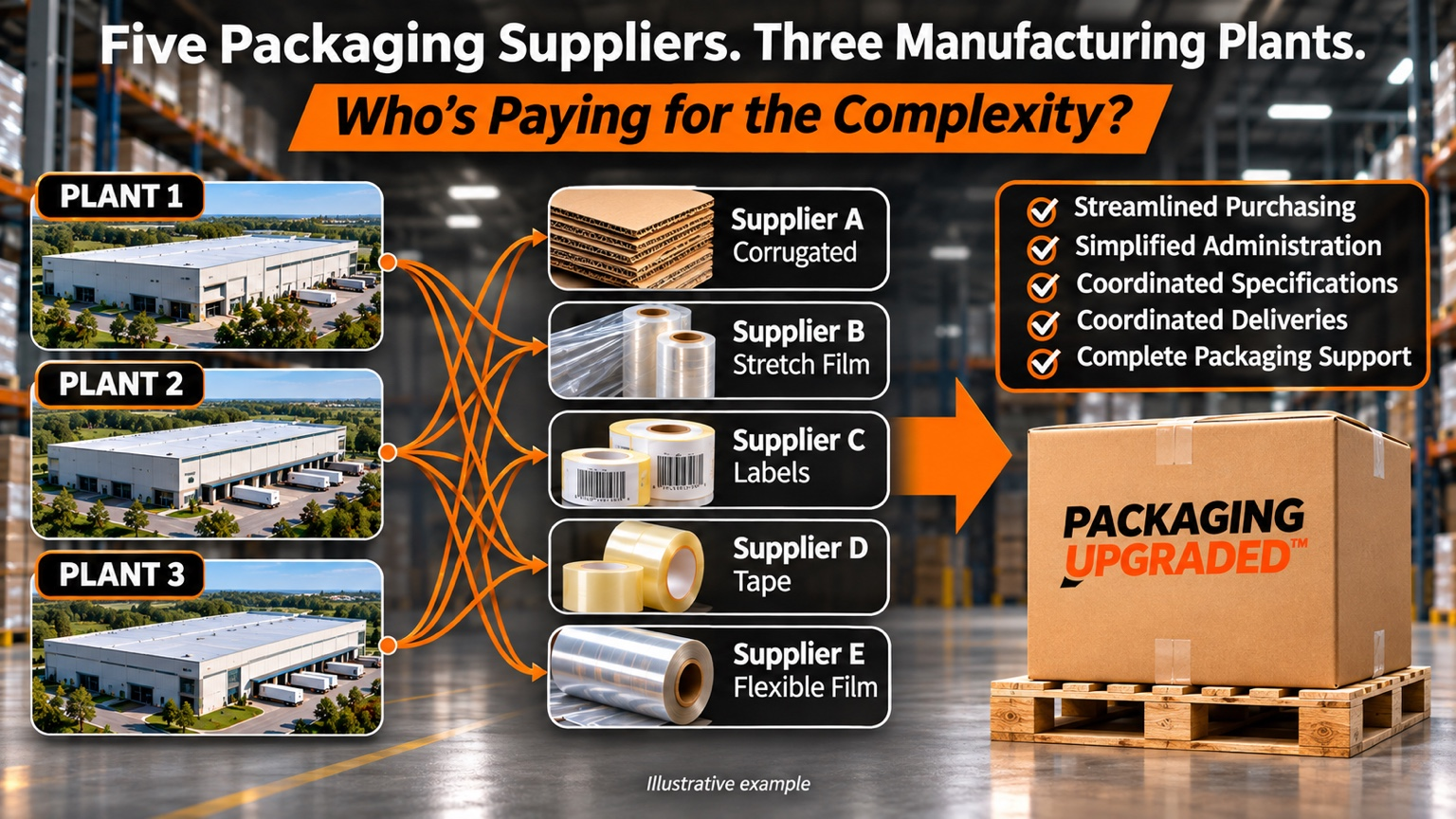
Managing more packaging suppliers doesn’t necessarily mean getting better pricing. Sometimes it means paying for the same work over and over again.
Imagine a manufacturer operating three production facilities.
One plant purchases corrugated boxes from two suppliers.
Another has separate suppliers for stretch film, machine tape, and thermal transfer labels.
The third facility buys many of those same materials but has established its own purchasing relationships.
Every supplier has been approved. Every facility is receiving its packaging. Production is running.
On paper, everything looks fine.
But across the company, how many people are managing purchase orders, tracking deliveries, resolving invoices, and maintaining packaging specifications?
And more importantly, what is all that coordination costing?
That’s where packaging supplier consolidation deserves a closer look.
The Hidden Cost of Too Many Packaging Suppliers
When purchasing departments evaluate packaging costs, they typically focus on material pricing.
What does the corrugated box cost?
What’s the price per roll of stretch film?
Can we save another two cents on a thermal transfer label?
Those questions matter.
But they don’t capture the complete cost of managing a packaging supply program.
Every supplier relationship can introduce additional administrative work.
Purchase orders need to be created. Deliveries need to be coordinated. Invoices need to be processed. Specifications must be maintained. Quality issues need to be resolved.
None of those activities are necessarily expensive on their own.
The problem is how often they repeat.
For manufacturers operating multiple facilities, the cumulative administrative burden can become substantial.
And it rarely appears on a packaging supplier’s quotation.
What Does Packaging Procurement Administration Actually Cost?
Consider a hypothetical manufacturer managing 15 packaging suppliers across three facilities.
Assume each supplier generates an average of eight purchase orders monthly.
That’s 120 purchase orders per month, or 1,440 annually.
Now assume purchasing, receiving, and accounts payable collectively spend an average of 20 minutes processing each order and its associated administration.
That represents 480 labor hours annually.
At an illustrative fully burdened labor cost of $45 per hour, that’s $21,600 in administrative effort.
| Purchasing activity | Illustrative annual amount |
|---|---|
| Packaging suppliers | 15 |
| Purchase orders per supplier per month | 8 |
| Total annual purchase orders | 1,440 |
| Administrative time per order | 20 minutes |
| Annual administrative labor | 480 hours |
| Assumed burdened labor rate | $45/hour |
| Estimated annual administrative labor | $21,600 |
This is a hypothetical calculation, not an industry benchmark or a documented Packaging Upgraded customer result.
It also isn’t a promise that reducing suppliers will reduce purchase orders proportionally.
Actual costs depend on purchasing systems, order frequency, invoicing arrangements, receiving processes, and how a company allocates labor.
But the exercise reveals something important.
Packaging has a purchasing cost and a cost of purchasing.
Both deserve attention.
Five Places Where Packaging Supplier Complexity Creates Friction
1. Multiple Suppliers Carrying Similar Packaging
It’s not unusual for different facilities to purchase similar corrugated boxes, stretch film, or shipping supplies from different sources.
Sometimes those arrangements make sense because of freight, availability, pricing, or equipment requirements.
Other times, they’re simply the result of each facility making purchasing decisions independently.
When companies compare these programs at the corporate level, they may discover opportunities to coordinate purchasing volumes, align specifications, or improve delivery planning.
The objective isn’t automatically to eliminate suppliers.
It’s to determine whether the existing purchasing structure still makes commercial sense.
2. Packaging Specifications That Aren’t Consistent
Two manufacturing plants may purchase what appears to be the same corrugated shipping case.
But are the specifications actually identical?
One plant might use a different board grade. Another may have modified the dimensions. A third may have a different packing or palletizing requirement.
Combining those purchases without reviewing the specifications could create serious operational problems.
That’s why multi-facility procurement should begin with an accurate item list and approved packaging specifications.
Our related article, Three Plants, One Part Number. Are You Quoting the Same Box?, examines why apparently identical corrugated specifications need to be verified before supplier quotes are compared.
3. Too Many Deliveries to Coordinate
Each supplier may have different lead times, minimum order quantities, production schedules, and delivery arrangements.
That can complicate receiving schedules, warehouse planning, and inventory management.
Consolidating selected purchases or coordinating deliveries may simplify certain operations.
However, it doesn’t automatically reduce freight costs. Manufacturing locations, shipment frequency, product availability, and transportation terms still matter.
The improvement must be measured against the actual delivery network.
4. Purchasing Time Spent Resolving Problems
What happens when the wrong label arrives?
Or a corrugated shipment is delayed?
Or the stretch film delivered to one facility doesn’t perform correctly on its wrapping equipment?
Every problem may involve a different supplier, contact, escalation process, and corrective-action procedure.
The more fragmented the program, the more difficult it can become to maintain consistent visibility.
A well-organized sourcing program should establish clear contacts, approved specifications, delivery expectations, and responsibility for resolving issues.
5. Missed Opportunities to Improve Packaging
A corrugated supplier may focus primarily on corrugated products.
A film supplier may focus on film.
A label supplier may focus on labels.
That’s understandable. Each has its own expertise.
But packaging performance often depends on how materials work together.
A different corrugated case configuration might improve pallet efficiency.
A revised stretch-film application could reduce unnecessary film consumption.
A better label construction might reduce scanning or application problems.
When packaging purchasing is evaluated across categories, those opportunities can become easier to identify.
The key is retaining appropriate technical expertise while looking beyond individual material prices.
Does Packaging Supplier Consolidation Mean Using Only One Supplier?
No. And this distinction matters.
Supplier consolidation and single sourcing are not the same thing.
A manufacturer might reduce its number of direct purchasing relationships while retaining multiple qualified manufacturing sources behind its supply program.
Another company may choose to keep separate suppliers for critical materials because redundancy is more important than administrative simplicity.
The Chartered Institute of Procurement & Supply (CIPS) identifies both potential advantages and risks associated with single sourcing, including administrative efficiency, purchasing leverage, and increased dependence on a selected supplier.
Reference: CIPS — Single Sourcing vs. Sole Sourcing
For manufacturers, the objective should be to simplify purchasing without creating unnecessary supply risk.
That could mean consolidating certain categories while maintaining approved alternatives for critical packaging materials.
Which Packaging Products Are Worth Reviewing Together?
For manufacturers and co-packers managing recurring production requirements, several packaging categories may be worth evaluating under a coordinated sourcing strategy.
These can include:
- Corrugated shipping cases, die-cuts, partitions, and protective components.
- Folding cartons and retail-ready packaging.
- Flexible packaging and printed rollstock.
- Thermal transfer and custom printed labels.
- Machine packaging tape and stretch film.
- Bulk bags, can liners, and industrial packaging supplies.
Not every supplier can manufacture every product category.
And not every category belongs under the same supply arrangement.
The opportunity is to identify where coordinated packaging sourcing and ongoing supply can reduce unnecessary complexity while preserving the specifications, expertise, and delivery performance each facility requires.
How to Evaluate a Packaging Supplier Consolidation Opportunity
Before changing suppliers, procurement teams should establish a reliable picture of their current packaging purchases.
Start with five questions.
1. How many packaging suppliers are we actually managing?
Include suppliers used across all facilities, not just those visible to corporate purchasing.
2. Which materials overlap between locations?
Identify common products, specifications, annual quantities, and purchasing patterns.
3. What does each supplier relationship require administratively?
Review purchase orders, invoices, delivery coordination, problem resolution, and supplier-management activities.
4. Where would consolidation create additional risk?
Consider qualified backup sources, production capacity, geographic coverage, tooling ownership, lead times, and business continuity.
5. Can we measure the improvement?
Compare total material costs, administration, freight, inventory, service performance, and any costs required to transition suppliers.
A successful consolidation program should improve the total purchasing operation, not simply reduce the number of names in a supplier database.
Three Plants Don’t Necessarily Need Three Different Packaging Strategies
Manufacturing facilities often develop purchasing arrangements around their immediate operational requirements.
That’s practical.
But as companies grow, independently managed packaging programs can become more difficult to coordinate.
Corporate procurement may see an opportunity to standardize purchasing. Plant managers may be concerned about losing flexibility or introducing production risk.
Both concerns are valid.
The answer is to identify which packaging requirements can be shared and which genuinely need to remain facility-specific.
A coordinated multi-facility packaging supply program should account for approved specifications, annual usage, plant-specific equipment, delivery requirements, and the operational consequences of making changes.
Standardization should make packaging easier to purchase and manage.
It shouldn’t make production harder.
Before You Negotiate Another Packaging Quote, Look at the Entire Program
Saving three cents on a corrugated box is valuable.
So is negotiating better pricing on stretch film or printed labels.
But purchasing departments should also understand how much time, coordination, and administrative effort goes into keeping those materials supplied.
Sometimes the next savings opportunity isn’t a cheaper product.
It’s a simpler purchasing process.
At Packaging Upgraded, we work with manufacturers, CPG brands, and co-packers to evaluate packaging requirements, coordinate sourcing, and support recurring supply programs across multiple facilities.
That includes reviewing specifications, purchasing volumes, delivery requirements, and opportunities to improve overall packaging efficiency.
The goal isn’t to eliminate every supplier. It’s to eliminate unnecessary cost and complexity while maintaining reliable supply.
Managing multiple packaging suppliers across several manufacturing locations?
Share the packaging categories you purchase, approximate annual volumes, and number of facilities involved.
Request a Packaging Efficiency ReviewYou may discover that the biggest opportunity isn’t in the next supplier quote.
It’s in how the entire packaging program is organized.
Packaging Upgraded | Packaging Engineered for Distribution