Packaging Costs & Optimization
Your Packaging Protects the Product. But How Long Does It Take to Pack?
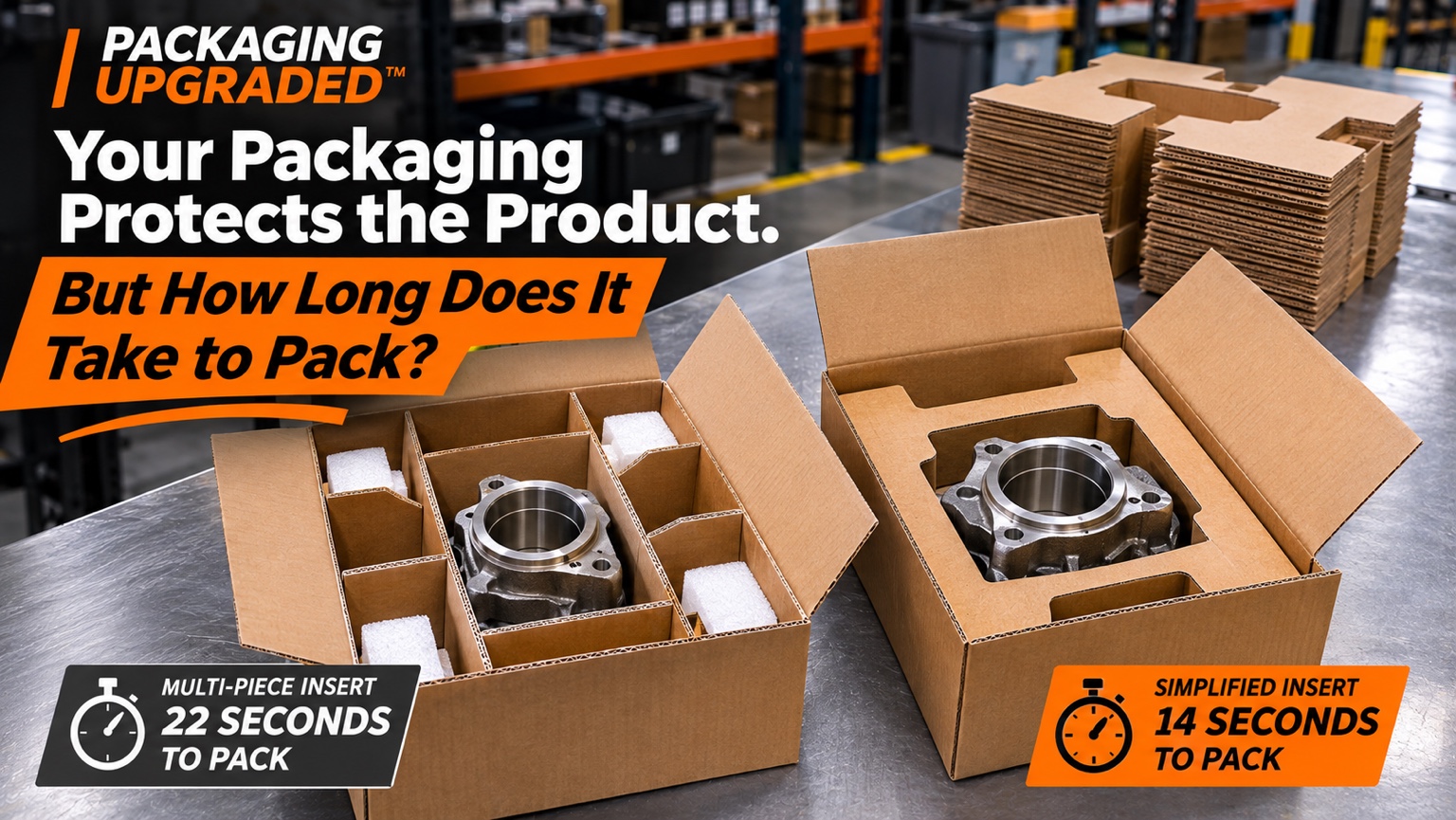
A packaging design can protect the product perfectly and still cost more than it should. Sometimes the extra cost comes from the time required to assemble it.
Imagine a manufacturer shipping 250,000 finished products annually in corrugated shipping cases with protective inserts. Products arrive protected, customers aren’t complaining, and purchasing is satisfied with the material price.
At the packing station, every operator has to fold an insert, position two protective pieces, place the product inside, and adjust everything before closing the box. Those extra seconds are easy to overlook until they’re multiplied across a full year of production.
What does the complete pack-out cost?
Prices for corrugated boxes, die-cut inserts, and protective components are visible on every supplier quote. Assembly labor is easier to miss. Someone has to fold the pieces, place them in the shipping case, position the product, and make corrections when the pieces don’t fit consistently.
Compare the material cost and the time required to produce a finished, acceptable pack. A lower material price can lose its advantage when the design takes significantly longer to assemble.
What do eight extra seconds actually cost?
Consider two hypothetical designs for the same manufactured product. Both provide acceptable protection under the intended distribution conditions. Design A takes 22 seconds to assemble and load. Design B takes 14.
| Measurement | Design A | Design B |
|---|---|---|
| Packing time per unit | 22 sec | 14 sec |
| Annual production | 250,000 | 250,000 |
| Annual packing hours | 1,528 | 972 |
| Assumed burdened labor rate | $35/hr | $35/hr |
Eight seconds × 250,000 units ÷ 3,600 seconds per hour frees about 556 hours per year. At $35 per hour, that’s roughly $19,444 in annual labor capacity value, calculated before rounding. These are hypothetical figures.
Cash savings depend on whether the business can reduce paid hours, overtime, staffing requirements, or other operating costs. The time freed can also create production capacity or improve throughput.
Why protective packaging becomes complicated
Designs built around damage prevention may require multiple folds, preassembled partitions, or components that fit in only one orientation. Operators may have to reposition parts before the case can close. Watch the pack-out to see which steps support or protect the product and where operators have to do extra work.
Five things to evaluate before approving a design
- Count the pieces. A shipping case, two die-cut inserts, a layer pad, and additional protective material each require handling. If a single insert could replace several pieces, test that construction against the same protection requirements.
- Time the assembly. Compare folding and interlocking steps, operator ergonomics, and consistency across shifts. Include adjustments and corrections in the timing.
- Check orientation. Look for inserts that can be installed backward or locking features that can be left partly engaged. A clear orientation feature can make loading more repeatable.
- Check product support. Control movement, support the correct contact points, and maintain clearance around vulnerable surfaces. Base those decisions on the product’s dimensions, weight, fragility, and distribution conditions.
- Run it on the intended equipment. Check case dimensions, loading orientation, folding requirements, and material stiffness on the manual, semi-automated, or automated process that will use it.
What custom corrugated inserts can do
Die-cut inserts, partitions, and protective components can make it easier to position a part and load it consistently. Evaluate those features alongside board selection, material cost, and distribution performance. Packaging Upgraded supplies die-cut supports, partitions, corner components, and multi-piece assemblies for manufacturers that need separation, support, or controlled positioning.
Explore corrugated inserts and protective packaging
What should procurement ask before requesting a quote?
- How many separate packaging components are used per finished product?
- How long does the complete packing process take?
- Which assembly steps are necessary for protection?
- Are operators frequently adjusting or repositioning components?
- Could a different design reduce handling time while meeting the same protection requirements?
- What is the annual production volume?
- Would the time saved reduce paid labor or free up production capacity?
Share the same pack-out details and acceptance criteria with each supplier so that purchasing can compare proposed constructions on the same basis.
Test the change before approving it
Compare the proposed design against the same protection requirements as the existing pack. Check fit and clearance with actual products, run a packing trial, and choose distribution tests appropriate to the intended shipping conditions. Depending on the application, those may include compression, vibration, or impact testing. The International Safe Transit Association publishes procedures for evaluating packaged-product performance.
International Safe Transit Association test procedures
Time the pack-out before negotiating the next price
For recurring production, a corrugated insert can affect material consumption, labor, production flow, and how well the product survives distribution. Packaging Upgraded evaluates those factors through its packaging design, engineering, and optimization services.
If you’re buying protective packaging in recurring commercial quantities, share the current configuration, annual volume, and how operators pack it.