Packaging Costs & Optimization
Your Stretch Film Is Cheaper. So Why Are Your Pallets Costing More?
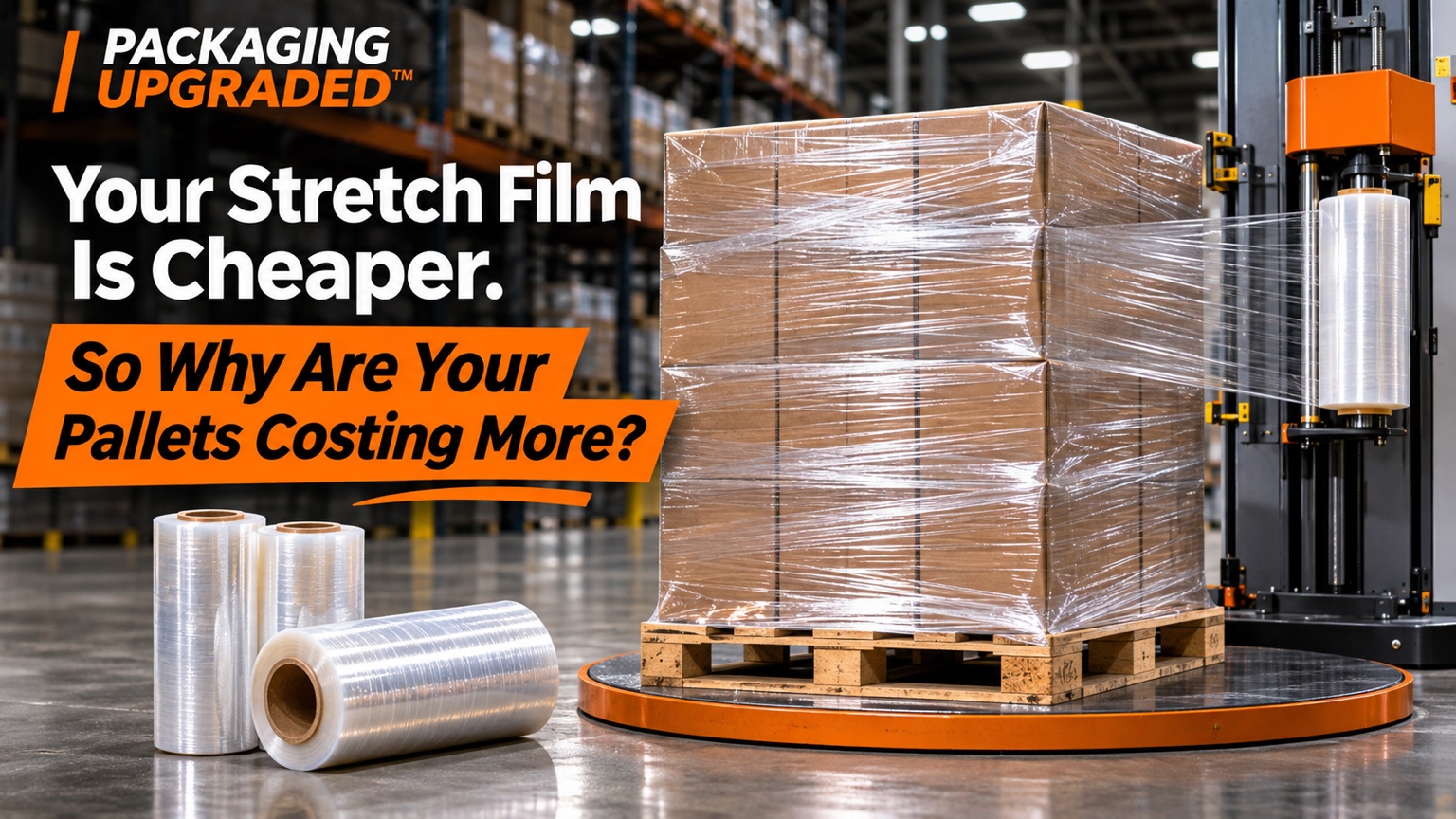
A lower price per roll doesn't always mean lower packaging costs. Sometimes the film that looks cheaper on a purchasing report ends up costing more on the production floor.
Imagine two stretch film suppliers quoting a high-volume manufacturing operation.
Supplier A offers machine film for $36 per roll.
Supplier B quotes $42.
Purchasing immediately notices the $6 difference.
For a company buying hundreds of rolls every month, that price gap looks significant.
But before approving the cheaper film, there's another question worth asking.
How many secure pallets will each roll actually wrap?
Because the cheapest roll isn't necessarily the cheapest way to move a pallet through distribution.
The Stretch Film Price Doesn't Tell the Whole Story
Stretch film purchasing is often evaluated using roll price, gauge, roll length, and sometimes cost per pound.
Those measurements are useful, but they don't fully describe how a film performs in an actual wrapping operation.
Two films can have different stretch characteristics, puncture resistance, roll yields, and compatibility with wrapping equipment.
The same machine may also require different settings to apply each film effectively.
One film might run with fewer interruptions and consistent containment.
Another might break more frequently, require additional wraps, or use more material per pallet to achieve acceptable performance.
That difference matters when a facility wraps thousands of pallets every month.
The purchasing objective should be the lowest total cost per adequately secured pallet, not simply the lowest price per roll.
A $36 Roll Versus a $42 Roll: Which Is Actually Cheaper?
Let's look at a hypothetical comparison.
Assume a manufacturing facility is testing two machine stretch films on the same type of pallet load.
Both films are evaluated under their appropriate machine settings, and both must meet the facility's required load-containment and distribution performance criteria.
| Measurement | Film A | Film B |
|---|---|---|
| Price per roll | $36.00 | $42.00 |
| Pallets wrapped per roll | 18 | 28 |
| Film cost per pallet | $2.00 | $1.50 |
| Annual pallet volume | 20,000 | 20,000 |
| Annual film expenditure | $40,000 | $30,000 |
Film B costs $6 more per roll.
Yet in this hypothetical example, it costs $0.50 less in film for every pallet wrapped.
Across 20,000 pallets annually, the difference is $10,000 in film expenditure.
That is a 25% reduction in calculated film cost per pallet.
These are illustrative numbers, not actual supplier quotations or a documented Packaging Upgraded customer result. Roll yields must be measured, and the comparison assumes equivalent acceptable load protection. Actual purchases may also be affected by roll changes, material waste, and rounding to whole rolls.
The example demonstrates why looking only at roll price can produce the wrong purchasing decision.
What Determines Stretch Film Cost Per Pallet?
Several factors influence how much stretch film is consumed during pallet wrapping.
1. Actual Film Yield
Two rolls with different prices may not wrap the same number of pallets.
Usable film length, film weight, application settings, and waste all affect yield.
The simplest purchasing comparison is to measure how many acceptable pallets each roll produces under controlled operating conditions.
2. Pre-Stretch Performance
Many machine stretch wrappers elongate film before applying it to a load.
For example, 200% pre-stretch means the applied film length is approximately three times its original length before stretching, assuming the machine achieves the intended stretch and the film runs successfully.
But a higher setting doesn't automatically create a better result.
Film characteristics, machine capability, actual delivered pre-stretch, and load containment all matter.
The correct setting is the one that provides suitable performance for that film and load, not simply the highest possible percentage.
3. Film Gauge and Construction
A thinner film may reduce material consumption, but gauge alone doesn't determine performance.
Load weight, carton geometry, sharp corners, puncture exposure, film construction, and wrapping conditions need to be considered.
Switching to a thinner film without testing can introduce unnecessary risk.
4. Wrapping Pattern
The amount of material applied depends on the wrapping program.
Bottom wraps, top wraps, overlap, carriage movement, film tension, and reinforcement settings can all affect consumption.
A facility wrapping stable, uniform boxes may need a different program from one handling mixed-size cases or irregular loads.
5. Breakage, Waste, and Rewrapping
Every film break or unnecessary rewrap can create additional material consumption.
It may also introduce labor, equipment downtime, or handling costs.
Those expenses rarely appear in a roll-price quotation.
Yet they can materially affect the total cost of a packaging program.
What Happens When the Pallet Isn't Secure?
Stretch film isn't simply a material used to cover a pallet.
One of its primary functions is to maintain load containment through expected handling and transportation conditions.
A pallet can appear tightly wrapped and still have inadequate containment.
If cartons shift, layers separate, or the load becomes unstable, the consequences can extend beyond the film itself.
Depending on the operation, these might include additional warehouse handling, rewrapping, damaged packaging, interrupted loading, or rejected shipments.
More film isn't always the correct answer.
The issue could begin with carton strength, pallet configuration, weight distribution, equipment settings, or the selected film.
Before increasing film consumption, the operation should identify the actual cause.
For a broader discussion, read our related article, How to Reduce Pallet Rework Costs Before the Next Shipment.
How to Calculate Your Current Stretch Film Cost Per Pallet
You don't need a complicated purchasing model to begin evaluating a stretch film program.
Start by establishing the actual results from your existing operation.
Record:
- Current roll price and usable roll specifications.
- Number of pallets successfully wrapped per roll.
- Pallet dimensions, height, weight, and load profile.
- Wrapper model and relevant application settings.
- Frequency of film breaks and abandoned wraps.
- Rewraps and additional material consumption.
- Whether the finished loads meet established containment and distribution requirements.
The basic material calculation is:
Stretch film cost per pallet = Total film material cost consumed ÷ Number of acceptable pallets wrapped.
For example, if a $40 roll produces 20 acceptable pallets without additional material waste, the film cost is $2 per pallet.
If the same roll produces only 16 acceptable pallets, that cost increases to $2.50 per pallet.
For a fuller total-cost comparison, account separately for measurable labor, downtime, waste disposal, rewraps, and other relevant operating costs. Avoid double-counting these costs where they are already included in the film or labor calculation.
Where practical, collect data over multiple rolls, shifts, and representative load types rather than relying on a single successful wrapping cycle.
Why Downgauging Needs More Than a Price Comparison
Downgauging means moving to a thinner stretch film.
It may create material savings when a suitable film and wrapping process achieve the required performance using less material.
But changing gauge isn't automatically an improvement.
Before approving a replacement, manufacturers should consider load containment, film break frequency, puncture exposure, actual consumption, machine settings, and transportation performance.
A reduction in film thickness is only valuable if the resulting packaging still performs under the intended distribution conditions.
For reference, ASTM D4649 addresses the selection and use of stretch wrap films, including considerations relevant to the performance of unitized loads.
Reference: ASTM International — ASTM D4649
Test methods and acceptance criteria should be selected to match the actual application.
Five Questions Purchasing Should Ask Before Switching Stretch Film Suppliers
Before approving a replacement film, purchasing teams should ask:
1. What is our actual film cost per pallet?
Calculate this using measured film consumption and acceptable completed loads rather than relying on roll pricing alone.
2. How does the new film perform on our existing equipment?
Confirm compatibility with the wrapper, actual achievable pre-stretch, tension settings, and normal production speeds.
3. Does the proposed film maintain required load containment?
Test representative loads under appropriate handling and distribution conditions.
4. Will the change affect labor, downtime, or rewraps?
Review film breaks, roll-change frequency, operational interruptions, and any additional material usage.
5. Can the supplier support consistent ongoing deliveries?
For manufacturers and distribution networks, film availability and repeatable performance can matter as much as a competitive initial quote.
Those questions produce a more useful comparison than asking which supplier has the cheapest roll.
The Best Stretch Film Program Looks Beyond the Roll
For high-volume manufacturing and distribution operations, film purchasing should be connected to pallet performance.
That means evaluating the film, wrapping equipment, packaging configuration, and actual distribution requirements together.
A lower-priced roll can still be the right choice.
But it should win because it delivers acceptable performance at a lower total cost, not simply because the quotation is cheaper.
At Packaging Upgraded, we supply machine and hand stretch film, machine tape, and related packaging materials for manufacturers, co-packers, and distribution operations.
Our pallet protection and load containment capabilities can be evaluated alongside current film usage, load configuration, and recurring supply requirements.
For multi-facility programs, we also review equipment differences, specifications, and delivery needs across locations.
Before negotiating another dollar off the price of a stretch film roll, find out what each roll is actually costing you per secure pallet.
Purchasing machine stretch film in recurring commercial quantities?
Include your current film specifications, estimated annual usage, wrapper model, and pallet configuration.
Request a Packaging Supplies QuoteThe lowest film price isn't always the lowest packaging cost.
Packaging Upgraded | Packaging Engineered for Distribution